While the World Watches Oil, Fusion Advances
Shockwaves from the U.S. and Israeli attacks on Iran are continuing to hit prices far beyond the gas pump. Because oil is still traded globally in U.S. dollars—a system dating back to agreements in the early 1970s—any disruption in oil markets also ripples through the dollar itself.
Shockwaves from the U.S. and Israeli attacks on Iran that began on February 28th are continuing to hit where most people felt them first: gas and oil prices. They’ve climbed rapidly, and that has consequences far beyond the gas pump. Because oil is still traded globally in U.S. dollars—a system dating back to agreements in the early 1970s—any disruption in oil markets also ripples through the dollar itself.
That connection affects not only gas and diesel, but housing, food, clothing and most other essentials. This influence is often overlooked or not understood. People just see prices climbing everywhere. But the current situation is demonstrating to the world beyond a doubt that most of modern life is connected to energy - and, in this case, fossil fuels.
We are witnessing a world where alternate energy could unlink all of us from the destructive forces of oil diplomacy, its resultant deadly atmospheric emissions, climate change, and the accompanying geopolitical reactions.
In addition, new power sources could have a strong stabilizing effect on economies worldwide.
Enter fusion - the ultimate new energy source.
Nuclear Fusion for Electric Power
It’s not exactly new, but it’s been easy to ignore. Wars, political drama, and economic crises tend to dominate headlines. As the old newsroom saying goes, “if it bleeds, it leads.” Quiet breakthroughs in energy, like fusion, don’t compete well for attention.
But here, new energy sources are the precise focus. My writing is about practical solutions—how we generate electricity, what it costs, and how new energy technologies are beginning to reshape not just energy markets, but the environment, household budgets, and even global finance.
Geopolitics May Be Where the Biggest Surprises Lie
If fusion delivers on its promise, it could significantly weaken the influence of oil-rich nations. They understand this, which is why many are investing in fusion research themselves—discreetly—while continuing to promote oil in public.
Meanwhile, work on fusion is well underway. Roughly 30 startups in the United States, along with dozens more worldwide, are developing fusion reactors. The science is no longer just theoretical. It’s been demonstrated. The engineering challenges are substantial, but progress is steady and accelerating.
For now, the industry remains mostly out of sight. That will change quickly when the first company produces usable electric power. At that point, what has been a quiet technical race will become front-page news.
And the first company success might not be American. Canada, Europe, Asia, and Australia all have active programs.
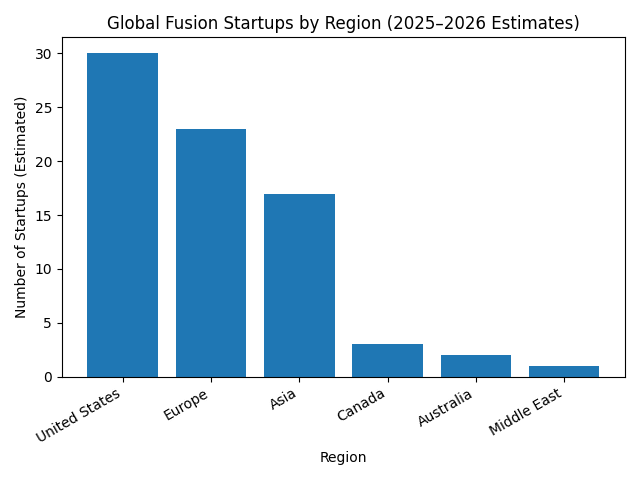
Estimated number of private fusion startups by region. The United States leads, but significant development is underway across Europe and Asia, with smaller but active efforts elsewhere. Estimates based on industry summaries and public company data (2025–2026)
There’s also ITER in southern France, a massive international collaboration. ITER itself won’t send electricity to the grid—it’s designed to refine reactor design and operation. Its successor, DEMO, for demonstration, is intended to take the next step: turning fusion heat into electricity for real-world use.
The appeal of fusion is straightforward. It doesn’t rely on fossil fuels. Most designs use isotopes of hydrogen derived from seawater. In that sense, it belongs alongside solar and wind—energy sources that draw on abundant, naturally available inputs rather than finite fuels.
All three shift energy away from traditional geopolitical control. No one owns the sun, the wind, or the oceans in the same way oil reserves are controlled. That said, geography still matters, and infrastructure still requires coordination, investment, and, inevitably, politics.
If successful, fusion would be a remarkably versatile power source. It could support data centers, electric vehicles (including heavy transport like trucks and rail), heating systems, and energy-intensive industrial processes—all without direct carbon emissions.
Skepticism Remains
Critics argue that while fusion has been demonstrated in laboratories—most notably at the National Ignition Facility in 2022 and again in 2023—it may never scale into a practical, widespread energy source. At best, they expect limited demonstration systems rather than something that meaningfully shifts global electricity supply.
In the meantime, the existing fossil-fuel system continues to dominate, supported by entrenched financial and political interests. Conflicts like the current one with Iran, and Ukraine as well, only reinforce how tightly energy, economics, and geopolitics remain intertwined.
But the broader trend is moving in another direction.
A New Era Is Beginning
By 2025, wind and solar together were generating roughly 17% of global electricity, often at lower cost than fossil fuels. In some regions, they’ve already met total demand for short periods. Expansion continues despite political resistance in some quarters.
Fusion, for its part, has cleared an important scientific milestone. Experiments at NIF produced roughly twice as much energy as was required to initiate the reaction. That doesn’t mean commercial power is imminent—but it does mean the underlying physics works.
From there, it becomes an engineering and scaling challenge.
Startups are making progress on key subsystems, and some are setting ambitious timelines. Helion Energy, for example, has announced plans to deliver fusion-generated electricity for specific applications such as data centers.
Helion offers a useful snapshot of how quickly this space is moving.
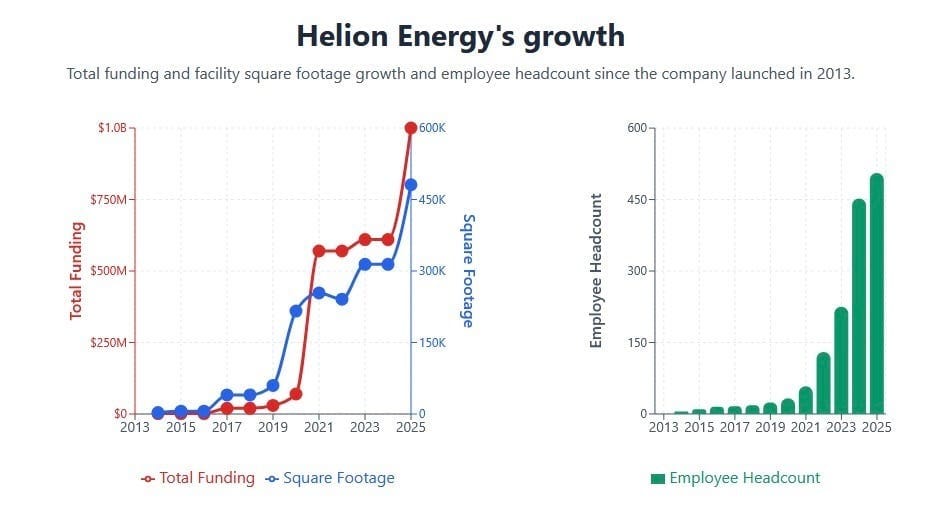
Source: GeekWire using Claude. Data provided by Helion Energy.
Helion has made an ambitious projection of at least 50 MW of electric power delivered to Microsoft by 2028. They reached a Purchase Power Agreement in 2023.
Fusion won’t be considered “real” in the marketplace until it consistently delivers power. But if and when that happens, the impact will be immediate—and global.
After decades of dependence on oil, even the first step toward a new energy system would mark a significant shift. I plan to be there and report.
References
https://www.iter.org
https://www.helionenergy.com
https://cfs.energy/technology/arc
https://www.geekwire.com/2025/helions-next-big-bet-is-fusion-power-manufacturing-at-scale-but-tech-uncertainty-remains/
https://www.fusionindustryassociation.org/learn-about-fusion-energy/